
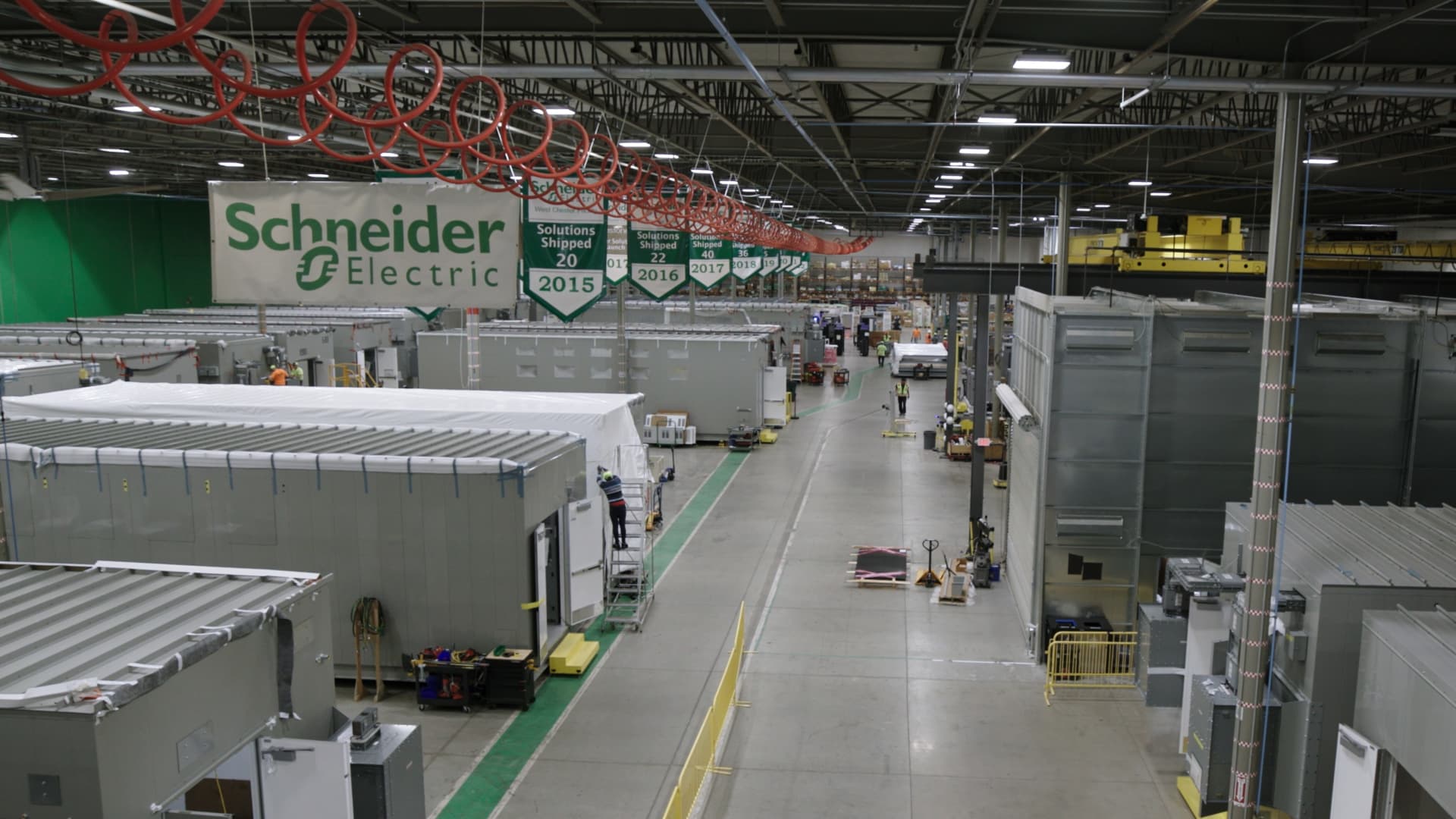
he Schneider Electric energy management strategy is rapidly becoming a cornerstone of Nvidia’s expanding AI infrastructure. Despite not producing electricity, Schneider Electric specializes in electrification and digitization—helping customers track and optimize energy use in real time. As the world’s largest energy management provider for data centers, which account for about a quarter of its business, the company now plays a vital role in supporting Nvidia’s push to develop sustainable, AI-ready infrastructure.
In June, Schneider Electric announced a collaboration with Nvidia to meet the soaring demand for efficient power, cooling, and control systems that enable the next generation of AI data centers. This research and development partnership aims to design energy-optimized “AI factories” across Europe and beyond. Just a month later, Schneider introduced a series of advanced data center blueprints—co-developed with Nvidia—that promise to accelerate construction timelines and make large-scale AI infrastructure more sustainable and easier to deploy.
The partnership focuses on two main innovations: integrated power management and liquid cooling control systems, along with a framework supporting Nvidia’s next-generation Blackwell chips. “We make sure that every new generation of chips can operate with minimal energy use,” said Jean-Pascal Tricoire, chairman of Schneider Electric. “AI chips consume massive amounts of power, so we’re bringing liquid directly to the chip to cool it efficiently.” With Nvidia’s recent $100 billion investment in OpenAI, Schneider’s role could prove extraordinarily profitable as demand for intelligent, energy-efficient infrastructure skyrockets.
According to Nvidia’s director of data center engineering, Scott Wallace, “We are entering a new era of accelerated computing, where integrated intelligence across power, cooling, and operations will redefine data center architectures.” This collaboration highlights how AI, despite its massive energy appetite, is simultaneously driving advances in efficiency—creating a feedback loop where technology both consumes and conserves energy at unprecedented scales.
Tricoire explains that this revolution is possible thanks to powerful computing systems capable of managing energy complexity in real time. “For the first time, we can analyze everything—what this data center is doing, what the grid can supply, what solar rooftops are producing—and ensure we consume the right energy at the right moment,” he said. “It’s a revolution of digital energy.” This new model integrates renewable sources like solar, wind, and geothermal energy into a decentralized grid, reshaping global power distribution.
This decentralized approach is also empowering individuals and businesses to become active participants in the energy transition. “If your home becomes energy-autonomous through solar batteries or EV charging, that freed capacity can power a nearby data center,” said Tricoire. “Everyone—from homeowners to large enterprises—can be part of this shift toward efficiency and sustainability.” He also emphasized how markets like Europe, India, and China are turning to electrification out of necessity, spurring innovation that pushes global competition and inspires U.S. companies to adapt, despite political resistance.
“Companies are pragmatic,” Tricoire said. “If a solution is profitable and improves sustainability, they’ll adopt it quickly. Costs for new technologies are dropping so fast that adoption is accelerating everywhere.” Having spent nearly 40 years with Schneider Electric, Tricoire says he’s never seen energy technology evolve this swiftly or profoundly. The convergence of electrification, digitization, and AI is, in his words, “the most underestimated revolution of the coming decades.”
“The exciting part,” he added, “is that these aren’t future concepts—they’re technologies we can deploy today, with strong economic returns.” As the Schneider Electric energy management approach reshapes how power is produced, distributed, and consumed, the partnership with Nvidia marks a defining moment in the transformation of global energy and digital infrastructure.